
| Latest News | ||||||
Mediacom wants to air Farmers' Market TV this spring, and since we are all geared up and have the broadcast equipment to do it, we could not resist. A few details need to be figured out, but we are well on our way to what we believe will be a successful outcome. As they say in the television industry, "Stay tuned." --Gary Olsen
|
||||||
| Join us on Facebook and Twitter! | ||||||
 We are on Facebook, Follow us and become part of the Farmers' Market TV Group. I will provide news and developments as they occur. I am so glad I kept this website maintained. You never know who is watching. We are on Facebook, Follow us and become part of the Farmers' Market TV Group. I will provide news and developments as they occur. I am so glad I kept this website maintained. You never know who is watching. |
||||||
|
||||||
 |
||||||
The production staff for Farmers' Market Live TV is helmed by national award winning media producer, Gary Olsen. Gary is assembling a talented team of professionals to meet the challenge of a series of live telecasts, and he's brought his considerable technical know-how to this project. It could be called a home-grown variety show that will appeal to a broad demographic because growing one's own food or buying locally grown food is becoming a movement of national proportions. This show plans to capitalize on the vast resources and topics available to us and endeavors to be both informative and entertaining. So how did this project get started? Gary produces two award winning series television shows for the Dubuque Community School District with whom he is employed as Media Developer. Kids in the Kitchen and The Garden Organic are shows that teach students how to grow and prepare their own food with emphasis on fresh produce rather than prepared or packaged food. For the past five years, Gary has always filmed an episode or two at the famous Dubuque Farmers' Market, a community, economic and cultural institution that has been going almost continuously for well over a century!
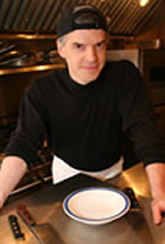
"Those shows were so popular," explains Gary, "I realized immediately that Farmers' Markets could form the basis for a television show. It has everything... gardening information, shopping tips on what's in season and how to choose good produce items, how to prepare fresh foods, and the best part, big crowds of Farmers' Market enthusiasts who shop every week. Farmers' Market combines shopping with cultural opportunities and just plain old neighborliness. People come to Farmers' Market to socialize." Also Gary noticed other features that would lend themselves to the show. "Local musical talent would perform for our camera. Local chefs who came down to connect with their suppliers would occasionally do cooking demonstrations. In fact," says Gary, "I would bring a chef with me to shop the market and talk to vendors, and he brought with him his own unique perspective on food. It was amazing."
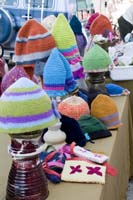
The landscape of Farmers' Market is continuously changing depending on what's in season. There are livestock producers, herb, flower and decorative plant vendors, and of course arts and crafts including soap and candle makers, a shoemaker and a wine maker or two. Then there are the food vendors who prepare local favorites like organic donuts, vegetable egg rolls, coffee, candy and bakery goods. "Farmers' Market is phenomenon begging to become a television show," says Gary with enthusiasm. "And we have the team that can do it professionally and with creativity." So what does it take to mount a production like Farmers' Market Live TV? It takes money, creativity, technical know how and talent. -Gary Olsen, Executive Producer December 2010 This is a project that I've been involved in planning for the past four years. I've thoroughly researched all aspects of mounting a production like this. And right now couldn't be a better time in the history of television technology to engineer a program like Farmers' Market Live TV. I wanted to use this opportunity to provide you with a glimpse into the technical design of the production. It is not a simple matter of just buying three cameras. This is designed to be a professional production in every way. In this this day and age, a television production of this design is best to own dedicated equipment rather than share equipment with another production, leasing or renting it. It's actually less costly over the long run. Today mobile productions don't use large expensive cameras costing $30,000 each requiring even more expensive support technology. Equipment today is lighter, faster, and more mobile. As a result, it is not practical to rent equipment for shooting schedules such as ours because of the logistics associated with renting. We are farther ahead by simply owning what we need to ensure dependability, flexibility and readiness. The Technology Television technology has taken the biggest evolutionary step since color television with the advent of high definition cameras that are smaller, lighter, and less costly, Cameras can go places that older heavier cameras cannot and still deliver a high definition, high quality video product. In this production scenario, our cameras can walk up to a vendor or into a booth and provide a more realistic and interesting point of view. Mounted on a Steadicam brace that the camera operator actually wears, there is fluid movement as the camera glides through the marketplace. The cameras are about $5,000 each and we need 3. I've been working with Steadicam technology for the past five years, and all of my television shows have been based on it. A single camera on a Steadicam brace provides a compelling image that puts the viewer into the scene. It's so much more interesting to watch than a static camera on a tripod for example. I like to say that a scene shot with a single camera on a Steadicam is more interesting than one shot with two cameras on tripods. Steadicam vests are approximately $5,000 each and we need two. Wireless technology is also available that frees the cameras to move about without having to be tethered to the production truck. Wires strung along the ground would not only be hazardous but inhibit the cameras from freely moving about the marketplace. Wireless transmitters and receivers are about $7,000 per camera and we need three. We can get by with two, however,a third unit can move from the stationary camera to an operator in the vent we have a down unit. A production switcher is next on our list, which is a device allowing us to switch between our live cameras and other video sources like computer graphic workstations and video servers. Our pick for live broadcast of high definition video is the NewTek Tricaster which sells for $12,000, We'll need some accessories in addition to a monitor for it, and that will add perhaps $2,000 to the cost of this important piece of equipment. Add to this an audio mixing board at $1500, and a laptop with graphics package to support the live telecast $1300. Now it has to all go into a production vehicle, and we feel the best one is the Dodge Sprinter, however there are other makes that match the Sprinter's overall dimensions and can be similarly equipped. We'll be looking to buy used, possibly a diesel. Plenty of headroom for three operators, one director on video switcher, an engineer on audio, and a graphics coordinator. These vehicles can be obtained used from $15,000 to $40,000 depending on model year, engine type, mileage, etc. But this would be a naked vehicle which we would have to customize for broadcasting. We may be farther ahead by buying a new vehicle from a custom shop like Frontline Communications of Clearwater, FLA., I recently found a Sprinter broadcast command vehicle with satellite uplink and fully customized for live television broadcasting for $42,000 on eBay Motors. Once we have the vehicle, it will require graphics, and Digital Designs in Dubuque has quoted us $3,000 to fully wrap the vehicle so that we make the best possible impression when the unit is on location. An important audience is the live audience wherever we travel, and it's a great opportunity to brand market our sponsors names and logos on the van. Microphones and accessories will be from Sennheiser, maker of sturdy reliable, high quality wireless equipment. Approximately $5,000 for Evolution Series ENG wireless microphone sets with rechargeable batteries are what we need to outfit two broadcast teams and our show's featured chef. An intercom system to connect the director with the camera crew and on-camera talent is an absolute necessity. We are still researching this, and I'm hopeful we will have figures shortly. I haven't listed everything we need for the startup capital, but so far our quotes on equipment from such firms as ECS (Davenport) combined with the vehicle comes to almost $200,000. And this doesn't include such things as portable burners for our cooking segment, wardrobe items for the on-screen crew (shirts and blouses embroidered with our logo, etc. I hope this has provided you with a snapshot of what is involved in the capital investment of a television production. It may seem like a costly endeavor, but the return on that investment in the form of a sustainable production that delivers a large and diverse audience is extremely worthy of the investment. |
 We are proud to announce we are working with Mediacom and OnMedia Precision Television Marketing on a limited initial run of Farmers' Market TV. We are producing this show as we wait for word on another project we have in the works, The Co-op Cookery, affiliated with the Dubuque Food Co-op project. It's a series of programs that will combine two of my favorite topics, cooking and gardening. But as the Co-op is the midst of raising funds for their eventual opening and operation, we have been presented with a marvelous opportunity too good to pass up.
 Gary Olsen is on twitter, and,quite frankly, who the heck isn't?
  elcome to the Farmers' Market Live TV Information Website. This site is our combination launch pad and collaborative journal as we move judicially toward our goal of producing this television show dedicated to the joys of gardening, buying and preparing locally produced agricultural products. Included in this mix are arts and crafts, but we won't stop there. Local musicians have found farmers' markets a way to connect with their audience so our music on the show will be home grown as well.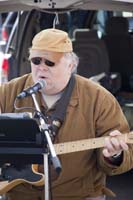

 The Pilot Episode stars Chrissy Hogue, Kimberly Feltes and Jim Terry. We are hosting our videos on YouTube which makes it available on everything from cellphones to tablets. The Pilot Episode stars Chrissy Hogue, Kimberly Feltes and Jim Terry. We are hosting our videos on YouTube which makes it available on everything from cellphones to tablets. |
||||||
How The Show Works Two hosts, each with a wireless camera operator, roam the farmer's market to talk with local growers, gardening enthusiasts, food purveyors, flower fanciers and the broad variety of market vendors. The show is broadcast live and a producer switches between the hosts' segments. This gives one host an opportunity to set up his next segment while the other host is on the air. The crews are linked by wireless intercoms to facilitate smooth transitions between segments. There is a third camera in the production that remains stationary perhaps shooting the overall scene from an elevated vantage point. It serves as a go-to shot in the event the segment cameras are not ready. The third camera also serves as a backup in the event there are technical difficulties with one of the other two cameras. We want to emphasize that this production is planned as a live television show, but the show's taping is intended for distribution and rebroadcast during the week following the live telecast. Because this is a show about gardening for the most part, the information is seasonal in nature.
There are feature segments: One segment of the show features a chef who is shopping for ingredients to prepare a dish live and on camera. The segment, "Shopping with the Chef," will endeavor to have a variety of chefs from the local culinary community on the show. Another segment is pre-recorded featuring one of the market's vendors and their garden, kitchen or studio. The idea is to record several of these segments ahead of time and have them loaded in the production vehicle ready to play, which is particularly useful in the event of a weather delay or technical difficulty.
Finally, there's are music segments featuring local musicians or groups that play Farmers' Markets. There will be at least one musical number per show preceded by a brief introduction. Following the segment there will be brief interviews with the musicians. Series Themes: The overarching theme of the series is to showcase local agriculture and regional foods. There are gardening "tools, tips and tricks" information we wish to convey. The cooking segment is designed not only to show people how to creatively prepare fresh and whole foods one can acquire at Farmers' Markets, but it's also intended to showcase local cuisine and the creativity of local chefs. We want to convey information about the value of organic farming and how to employ natural ways of growing food without chemicals that can harm the environment and our health. We want to showcase the talents of local artisans and craftsmen who are among the mix of people selling their products at Farmers' Markets. |

 he concept of farmers' markets are a growing phenomenon in America as citizens endeavor to get back to their pre-manufactured foods roots where almost every household had a garden, and children actually knew where their food came from (not just the super market). It's a venue that begs to become a television series with infinite possibilities. It represents an almost inexhaustible list of topics from gardening and organic farming to diet and nutrition, from crafters and cooks to entertainers and farmers' market enthusiasts. It's not just about the promotion of local food sources, but about a community's culture. A farmers' market in Dubuque, Iowa would be totally unique from one in New Orleans, Louisiana.

 resently there are approximately 225 farmers’ markets in Iowa. However, only 20% of the food we serve on our tables is sourced in Iowa. That means 80% of the food Iowans buy comes from out of state and out of the country. There are efforts going on right now throughout the state to improve the opportunities for growers to access local markets for their products. A growing number of consumers, enthusiastic about buying local foods, account for the increased number in farmers’ markets that put local
  growers in direct contact with their customers. Even though farmers’ markets have been around for a long time, new generations have yet to discover the joys of buying fresh produce, cooking from scratch and gardening.
However, these trends in promoting local food sources, though encouraging, still have a long way to go to actually impact the diets and nutrition of Iowa families. Obesity and the diseases it causes are highest among populations in the US and Mexico than nearly every other nation in the world. In the US, lifestyles have favored prepared, processed and convenience foods over more natural, healthy foods.
Gardening, growing one's own food and preserving one's bounty were very popular enterprises practiced in the first half of the 20th Century, but convenience and economy in the second half of that century displaced much of these valuable skills.
Ironically there has never been a better time to start gardening. Advances in gardening tools, techniques and technology now make gardening more accessible through innovations such as raised beds, easy-to-apply organic fertilizers, environmentally sustainable pest management and other advances.
Proof you can raise food just about anywhere including a building's flat rooftop, there is an agricultural revolution in several of our urban areas, most notably in Milwaukee, Wisconsin, lead by Will Allen, former NBA player and now MacArthur Foundation supported de facto leader of a national urban farmer movement. Allen is telling Americans, “We are not teaching our kids to be farmers. As a result, many children don't know where there food actually comes from. And in some areas of our nation, not just urban areas, there are 'food deserts' where no fresh, healthy affordable food is grown much less available.”
Over the last half century, small farmers have been supplanted by industrialized food producers that add little in terms of nutrition to the foods we eat but guarantee lower consumer prices. It becomes a conflict of quantity and freshness vs quantity and price. Processed foods contain high levels of of sodium and sweeteners that add unwanted calories that contribute to our nation's obesity epidemic. In restaurants across the nation, fast food becomes fat food and children are particularly susceptible.
We need a way to encourage and share the knowledge of the joys of gardening, locally grown foods and how to prepare natural dishes with fresh, natural ingredients especially with our younger generations. This is an educational process that is best advanced by the medium of television.
Our project represents a public education effort in a compelling, entertaining format designed to
-
Educate consumers, specifically those ages 12 – 45, to the availability and wholesomeness of locally grown food.
-
Educate the consumers on the preparation and preservation of fresh produce.
-
Educate the general public on the virtues of gardening and growing one’s own food.
Our plan is to launch our program on KWWL Television that serves Eastern Iowa and where nearly half of Iowa's farmers' markets thrive. The series would feature farmers, chefs, artisans and shoppers in a weekly broadcast called Farmers’ Market Live TV.
Our project is designed to create a continuous and sustainable means of communicating the virtues of gardening, preparing, preserving and consuming locally grown food.
Farmers’ markets have grown in size and numbers, especially in Iowa. Farmers’ markets have become gathering places and venues for entertainers, craftspeople, and artisans. They have taken on the cultural identity of their communities showcasing local talent. Farmers' markets have become a profound source of pride for a community. Our series intends to explore and feature these sources of community pride.






© 2011 Gary Olsen Digital Media Design. Images on this page other than those of the project team are used with permission or otherwise attributed. |